Sophie
How do I optimize my product data for Amazon and eBay?
Amazon and eBay are among the largest marketplaces in German online retail. Alone, Amazon alone brings together around 63 percent of German online trade For many small and medium-sized retailers, both platforms are therefore part of their sales strategy. However, their requirements for product data differ significantly.
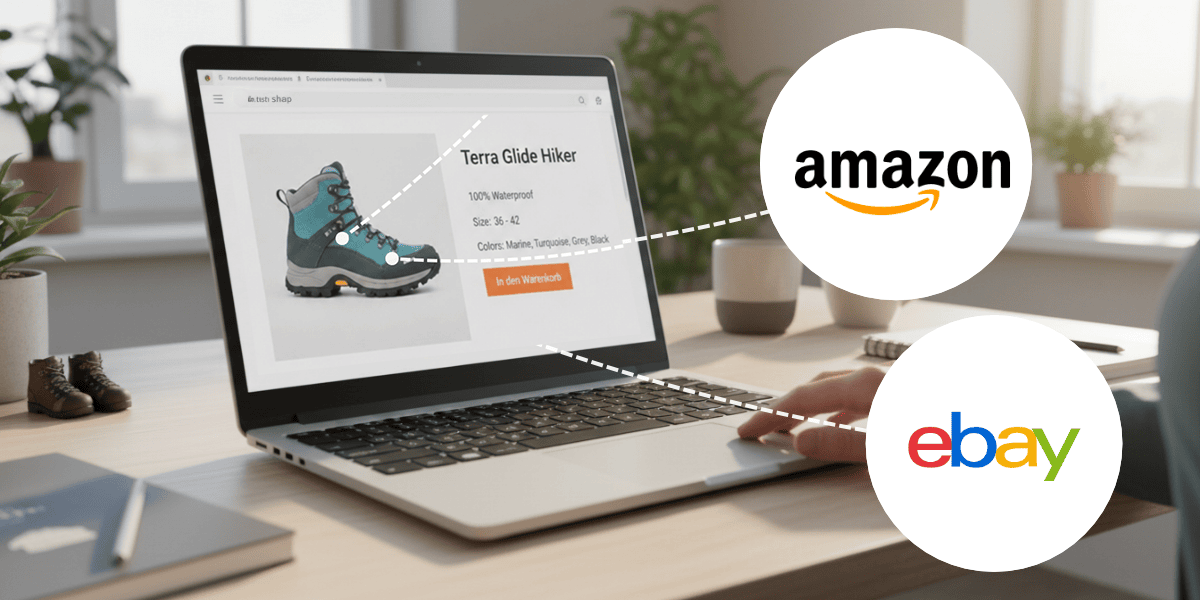
Which product data determines visibility on Amazon and eBay?
Just like customers, platforms also need information to properly categorize a product: titles, attributes, categories, variants, images, and structured descriptions. The more complete and consistent they are, the better the marketplace understands your offering.
- Title: It is the first thing buyers see in the search results.
- Category: It determines the environment in which your product appears and the filters that it is displayed with.
- Attributes and article characteristics: Brand, color, size, material and other characteristics serve as filters and for the assignment.
- Images: Especially the first image can be seen in the hit list.
- Variants and product designations: They ensure that sizes, colors, and identical products fit together properly.
How do Amazon and eBay differ in terms of product data?
The main differences at a glance:
| Area | Amazon | eBay |
|---|---|---|
| Title | From July 2026, the title can be no longer than 75 characters (except for media). Additional information is included in the article highlights, which can be up to 125 characters long. | Up to 80 characters. eBay recommends taking full advantage of them. |
| Attributes | Required and recommended fields depend on the product type and category. There are category-specific style guides. | Required and recommended article characteristics per category. In some categories, for example Fashion and Home & Garden, they are mandatory. |
| Images | Main image on a pure white background (RGB 255, 255, 255); the product fills approximately 85% of the area, with at least 1,000 pixels on the longest side for the zoom function. | The first image appears in the search results. Current image specifications are available in the eBay seller portal. |
| Condition | Defined depending on the category. | According to eBay, the information must be provided consistently in the title, description, and product features. |
| Visibility | Rejections and notes often do not specify the exact reason. Systematically check titles, character lengths, and special characters. | According to eBay, complete article features increase the chance of being found in search results and filters. |
How do you optimize titles for Amazon and eBay?
Describe the product clearly and in a consistent order: brand, product type, model, important features. Avoid promotional phrases and capital letters. On eBay, the most important search terms should be placed as far forward as possible.
Example (fictitious product):
| Title | Characters | |
|---|---|---|
| Raw data from the shop | Coffee grinder KM-200 black electric stainless steel NEW Top price!!! | 59 |
| Amazon (Limit 75) | Model Brand KM-200 Electric Coffee Grinder, Stainless Steel, Black | 62 |
| eBay (Limit 80) | Model Brand KM-200 Electric Coffee Grinder Stainless Steel Black Cone Grinder 150 W New | 80 |
The raw data title contains abbreviations, promotional words, and no brand name. For Amazon, the title remains concise and factual; for eBay, you use the greater leeway to include additional search terms. Important: Everything that appears in the title must also be consistent with the attributes.
How do you organize categories and attributes correctly?
Each marketplace has its own category structure. A wrong category costs visibility because your product appears in the wrong filters and environments. Missing mandatory attributes can lead to rejection.
Here's how to proceed:
- Compare category trees: Organize your shop categories according to the categories of Amazon and eBay.
- Determine the mandatory attributes for each category: On eBay, use the list of item characteristics for your category; on Amazon, use the category-specific specifications.
- Closing gaps: Supplement missing attributes in your data source, instead of maintaining them individually for each marketplace.
- Rules for creating entire category trees: This saves time because you don't have to make an assignment for each product individually.
What should you pay attention to when creating product images?
The main image is strictly regulated on Amazon: a white background, the product fully visible and only once, no props that are not part of the delivery package. On eBay, the first image is crucial, especially in the search results. Therefore, for each product, create a main image that meets the requirements of both marketplaces and add additional images for details and usage.
How do you proceed step by step when optimizing product data for different marketplaces?
- Check the data base: Are the titles, brands, product identifiers, attributes, and images complete and consistent? Poor raw data cannot be saved by rules.
- Collecting requirements per marketplace: Title rules, mandatory attributes, and image requirements for your categories.
- Assigning data fields: Decide which field of your source flows into which field of the marketplace.
- Rules for title and attributes: For example, combine a title with the brand, product type, model, and color and tailor it to each marketplace.
- Check data quality: Look for missing mandatory attributes and conflicting information before you play the data back.
- Evaluate and follow up: Check for error messages and notes from the marketplaces and adjust the rules accordingly.
How Channel Pilot Pro can help you optimize product data
With Channel Pilot Pro You don't have to go through the six steps manually. Our Artificial intelligence takes on the preliminary work: The data quality analysis finds missing or conflicting fields, the AI Category Mapping suggests appropriate categories for each marketplace, and the AI Formula Generator Creates rules for titles and attributes from a prompt. You decide the outcome and can customize each rule. Learn more about product data optimization with Channel Pilot Pro here.
Channel Pilot Pro combines marketplace connectivity, feed management, and dynamic pricing into a single solution. This way, you can manage product data, marketplaces, and prices in one place. We would be happy to show you in person how this looks for your product range.
Frequently asked questions about product data optimization for Amazon and eBay
Titles, categories, attributes or article characteristics, variants and images. These determine how well platforms understand and display your product. The lack of mandatory information or conflicting data can lead to rejection and reduced visibility. Therefore, start with a complete data base.
On eBay, the maximum length is 80 characters. On Amazon, the maximum length has been set to 100 characters since July 2026 a limit of 75 characters, except for media. Check the limit for your category im Amazon Seller Central, Because the requirements are changing can.
No. You maintain product data as a common base once. However, marketplaces often require different titles, attributes, or categories. You can bridge these differences with channel-specific rules into the base, instead of manually editing each offer. This keeps the data consistent and saves you time.
Yes, but only manually. With wide product ranges or frequent changes, this quickly becomes time-consuming and prone to errors. A tool with rules and data verification helps to maintain quality consistently across all channels.
Typical signs include products that are not being displayed correctly or at all, refusals, indications from marketplaces, or low visibility despite demand. Then, check the mandatory attributes first, category and title, because these are the most common causes.
Sophie
Content & Social Media Marketing Managerin
Sophie writes about e-commerce, digital retail, and everything related to marketplaces. She tracks trends, analyzes developments, and breaks down even complex topics in an easy-to-understand way. As a trained editor, she brings a keen sense of language, storytelling, and target audiences—and applies these skills today in content and social media marketing at Channel Pilot Solutions. When she’s not brainstorming new content ideas, she loses herself in a good TV series or works up a sweat exercising.