


Christina
ChatGPT Ads: The Complete Guide for Advertisers (2026)
Since August 24, 2026, it is official: ChatGPT Ads are live in Germany. Users of the free ChatGPT plans are now seeing ads in the chat, creating an advertising channel for brands that functions fundamentally differently from anything Google Ads or Meta Ads have offered before. Instead of bidding on keywords, you place your message directly in the moment of a real purchasing decision—right where people are no longer googling, but asking.
What is striking about this: Much of what circulated about ChatGPT advertising in recent months was hearsay or half-baked – no working feed, no measurable benefit. That is over now.

What are ChatGPT Ads?
ChatGPT Ads are paid advertising placements, clearly labeled as „sponsored,“ that below a ChatGPT response appear if they are thematically suited to the conversation context. They are separated visually and in content from the actual AI response: the chat text itself remains ad-free, with the advertisement following separately underneath.
A ChatGPT ad consists of the following elements:
- Visual material (promotional material)
- Name of the advertising company
- Favicon (Logo)
- Title (Heading)
- Ad text (description)
- Linked landing page
For me, this is a completely new touchpoint: people who are actively researching, comparing, and preparing decisions in ChatGPT encounter an offer at that exact moment—not afterward via a retargeting banner, but right in the middle of the decision-making process itself. That is precisely what makes the channel so exciting from a marketing perspective.
Since when have there been ChatGPT Ads in Germany?
ChatGPT ads are now generally directly bookable in Germany. OpenAI enabled self-service access to the Ads Manager on August 31, 2026, for 31 European markets, including Germany. Companies can thus basically set up campaigns independently without necessarily having to go through the OpenAI Ads Solutions Team or an agency or technology partner. However, access applies to eligible advertisers and requires, among other things, that the advertising and billing legal entity is located in a supported country.
My assessment: ChatGPT Ads are no longer just an announced or exclusively accessible test channel in Germany, but are generally available on a self-service basis. Anyone wanting to test the channel should therefore prepare their feed, conversion tracking, landing pages, and messaging now. Especially in the early phase, a controlled test with a clear measurement logic is recommended – not just focusing on clicks, but also on qualified leads, conversion quality, and actual business value.
How do ChatGPT ads work?
Placement and format
Ads appear exclusively at the end of a ChatGPT response, never in the middle of the response text. They are clearly marked with a „Sponsored“ label and visually distinct from the actual conversation content.
Selection and delivery
Which ad is displayed depends on several factors:
- the current conversational context (topic, intent, phrasing of the question)
- the ad itself (title, description, landing page)
- provided by the advertiser Context Hints More on that in a moment
- optional: previous chats, saved memories, and past interactions – but only if the user has actively allowed personalized ads
Advertisers receive this no access to individual conversations or user data. OpenAI expressly emphasizes that chat content is not sold or shared with advertisers.
Who sees ChatGPT Ads—and who doesn't?
Ads appear exclusively in the plans ChatGPT Free and ChatGPT Go. All paid plans – Plus, Pro, Business, Enterprise, and Edu – will currently remain completely ad-free.
This is strategically relevant: ChatGPT now has around one billion weekly active users worldwide and over one billion app users. Even if only a portion of them are on Free/Go plans, this results in enormous visibility potential – especially since, according to OpenAI, around 20 percent of all ChatGPT conversations already have a commercial intent contain.
Do ads influence ChatGPT's responses?
No. OpenAI is technically separating advertisements and the actual chat model completely. Advertisers can neither shape nor influence the content of the generated responses, rank them higher, or alter them. A displayed ad is therefore expressly not a recommendation by the model—it is a separate, labeled placement.
This strict separation is also the reason why classic retargeting is currently not possible with ChatGPT Ads: there is no individual user tracking for advertising purposes. Targeting works contextually instead.
How targeting works: Context Hints explained
Unlike Google Ads, ChatGPT not with a classic exact-match keyword logic. Instead, advertisers define so-called Context Hints – thematic notes describing the conversation situations in which an offer might be relevant.
An example: Instead of the keyword „book LinkedIn training“, you formulate context hints like:
- „Company looking for LinkedIn training for sales, marketing, or recruiting“
- „A sales team wants to make better use of social selling or the Sales Navigator.“
- „HR or Recruiting wants to use LinkedIn more professionally for active sourcing“
The decisive difference: It is not the exact search term that counts, but the conversation situation and the underlying user intent. In my view, that requires a real shift in mindset compared to traditional SEA logic—anyone who has previously thought only in terms of keywords now has to think in scenarios and needs. That is also the reason why I recommend that marketing teams not simply derive context hints from existing keyword lists, but rather formulate them anew from the customer's perspective.
How much do ChatGPT ads cost?
OpenAI currently supports three billing models:
| Model | Description |
|---|---|
| CPM | Cost per 1,000 impressions – for reach objectives |
| CPC | Cost per click – for performance-oriented campaigns |
| oCPC | Conversion-optimized CPC – ad delivery is additionally optimized toward a defined conversion event |
Regarding the cost trend: Costs in the impression-based model have fallen significantly since launch: from an initial roughly 60 US dollars per 1,000 impressions to, in some cases, much lower values today, as competition in the auction system increases with growing advertising volume. According to OpenAI, costs per acquisition are also continuously trending downward..
New since September 2026: Conversion Optimization
In addition to manual CPC and CPM, OpenAI now offers automated bidding strategies: With „"Maximize results"“ Does Ads Manager automatically optimize bids toward a chosen campaign objective. Since September 2026, in addition „Conversion Optimization“ generally available: The Ads Manager automatically bids on a specifically defined conversion event rather than just the click. According to OpenAI, the cost per result is thus on average around 44 percent lower than what classic click bidding achieves. For you, this means: As soon as your campaign has collected enough conversion data, it is worth switching from manual CPC bidding to a conversion-optimized bidding strategy – this saves both budget and optimization effort.
Practical note on the minimum budget: In initial test accounts, the lower limit suggested by the Ads Manager is around 25 US dollars daily budget. This is not an officially communicated, universally valid minimum budget, but it provides a realistic guideline for initial tests.
The OpenAI Ads Manager: Access and Setup
The Ads Manager Beta is the central interface for creating, managing, and evaluating ChatGPT Ads campaigns. OpenAI lists five steps for the initial setup:
- Ads Manager open and create an account
- Complete account onboarding and verification
- Complete account information
- Set up billing and payment
- Invite team members
This is followed by the actual campaign creation:
- Select campaign objective: Reach (CPM), clicks (CPC), or conversion-optimized clicks (oCPC)
- Set budget and duration: Daily or total budget, start and end date
- Select destination country and platform: e.g., Germany, Web (desktop + mobile web) or App
- Create ad group: including context hints
- Create ad: Title, description, destination URL, logo, and image – partially pre-filled automatically from the website
- Set up conversion tracking: data source, conversion event, OpenAI Pixel or Conversions API
In Ads Manager itself, impressions, clicks, costs, click-through rate, average CPC and CPM, as well as set-up conversions can then be evaluated – albeit only at the campaign, ad set, and ad level, not at the level of individual user queries.
ChatGPT Ads for E-Commerce: Product Feed & Shopping
For online stores, this is particularly relevant: Product placements in ChatGPT require a structured product feed – comparable to what Google Shopping or Meta Shopping already require today. The good news: Anyone who already runs a working Google Shopping export does not have to start from scratch. The existing feed can be reused almost 1:1, with just the addition of three fixed, extra values.
That is precisely what makes ChatGPT Ads one of the lowest-barrier new advertising channels currently available for existing e-commerce clients—provided the feed infrastructure is already in place.
How to set up your ChatGPT export with Channel Pilot Pro
If you are already exporting your product range to Google Shopping via Channel Pilot Pro, getting started with ChatGPT Ads takes just a few minutes:
1. Log in to OpenAI and open an ad account at ads.openai.com/de-DE
2. Go to your Channel Pilot Pro account
3. In the FeedEngine section, add the "ChatGPT" channel
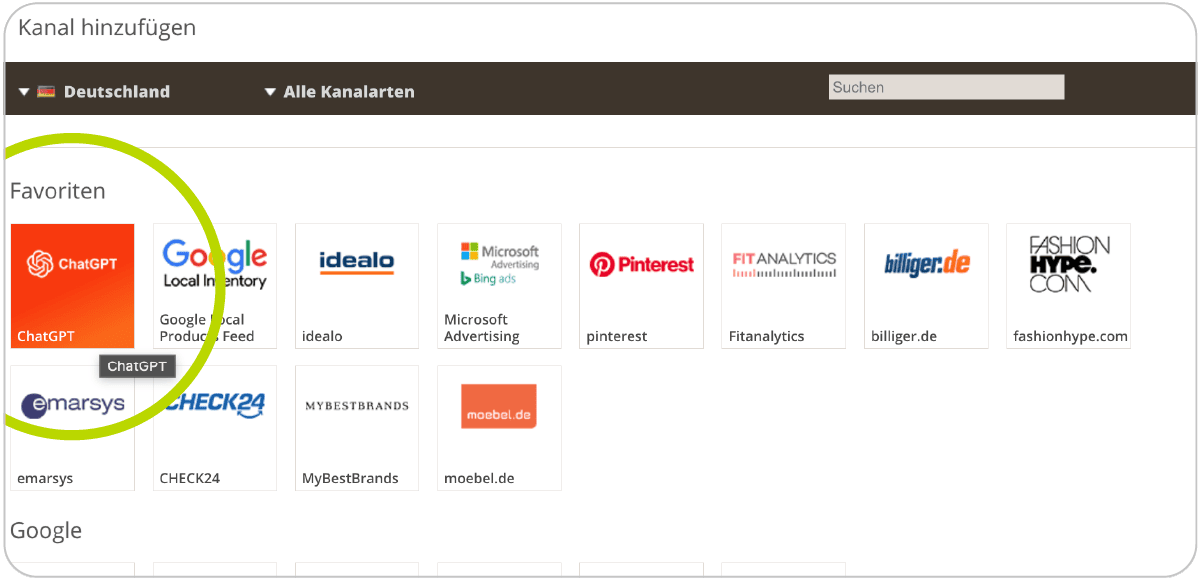
4. Simply copy the required fields from your Google Shopping export—there are only three additional values to add: is_eligible_search = true, is_eligible_checkout = false, is_ads_eligible = true
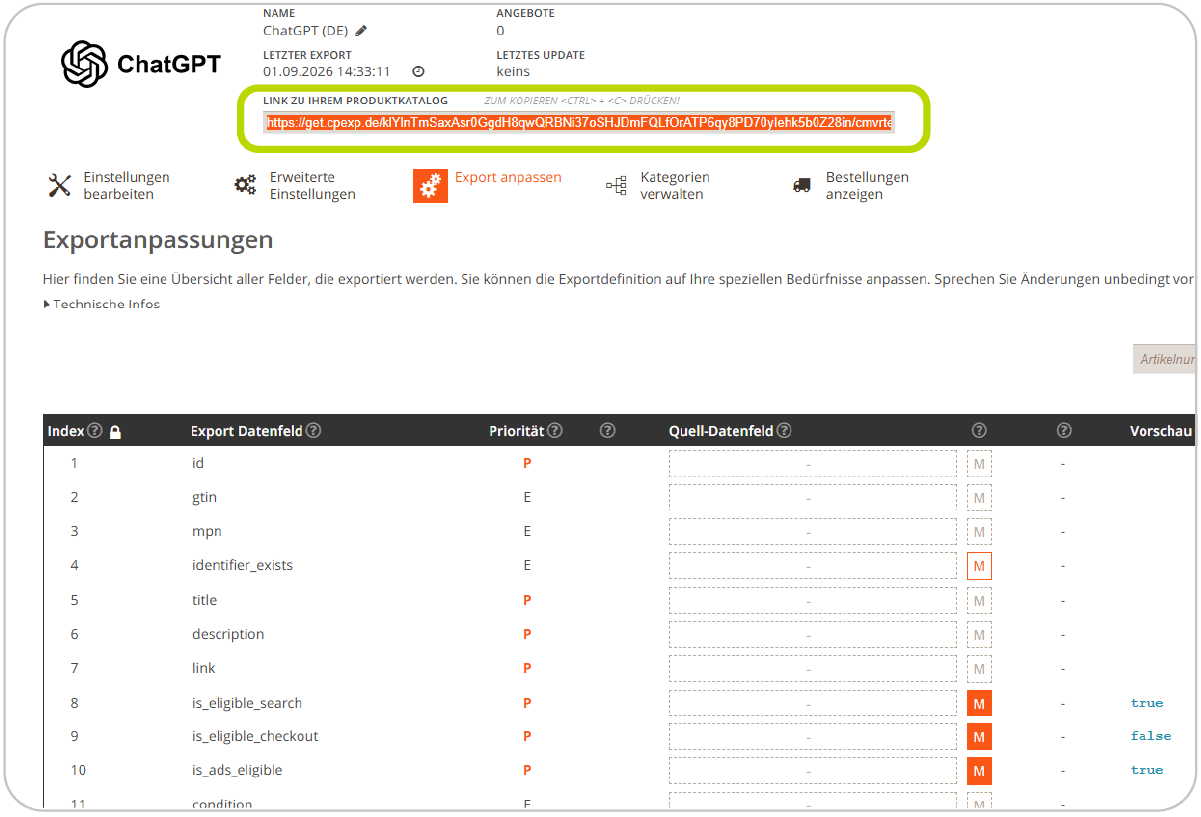
5. Save, test, enter export URL in the OpenAI Ads Account – done.
Five minutes of effort, a completely new sales channel. Those who start now gather insights while the competition is still wondering whether the topic is even to be taken seriously. Stuck at any point? Just reach out to your account manager—they will be happy to help you with the setup.
Conversion TrackingPixel, Conversions API & GTM
Technically, creating campaigns is now easier than clean conversion tracking. OpenAI supports two measurement methods, which can also be used in combination:
- OpenAI Pixel: is triggered after a defined conversion event (e.g., „lead created“ or „order completed“)
- Conversions API (CAPI): server-side transmission of conversion data, more robust against consent and blocker restrictions
A typical setup for a form conversion looks like this: ChatGPT ad → landing page → form submission → Google Tag Manager → OpenAI pixel event.
Important for German websites: From a technical standpoint, the pixel may only be loaded after the corresponding consent has been given. Anyone who does not properly couple consent management with tracking risks not only inaccurate data, but also a GDPR violation.
One structural limitation remains: OpenAI does not disclose individual conversations or specific search queries. The analysis is therefore possible at the campaign, ad group, and ad level—not at the level of individual prompts. In addition, many users research in ChatGPT but make purchases in another channel. A pure last-click attribution can therefore underestimate such earlier touchpoints.
Why ChatGPT Ads Isn't a Replacement for Google Ads
A question I have encountered frequently in recent weeks: Is ChatGPT replacing Google Ads, or is it just another channel that ties up budget without delivering real added value? My answer to this is clear: ChatGPT Ads are not a substitute, but rather a standalone channel with its own logic.
Google Ads captures demand that has already been formulated as a search term—someone knows what they're looking for and types it in. ChatGPT Ads, on the other hand, reach people in the Evaluation phasewhen requirements are described, options are compared, and arguments are weighed against each other, but no final decision has been made yet. That is not a better or worse phase of the customer journey – it is a different one. And precisely for this reason, both channels complement each other instead of cannibalizing one another.
Structurally, too, the two platforms differ significantly: Google Ads uses keywords, exact-match search terms, and offers the option for remarketing. ChatGPT Ads uses context hints and aggregated campaign data rather than individual conversations, and remarketing is simply not technically supported at this time. Anyone who tries to apply their Google Ads playbook directly to ChatGPT will be disappointed—but those who understand that this platform serves a different user intent can use it strategically as a complementary channel.
What I want to make clear in this context: I am not advising anyone to start blindly and with large budgets just because a channel is new. I advise testing now while the competition is still waiting—with a cleanly measured, small budget, real learnings, and the willingness to learn from the first few weeks. Being a first mover does not mean investing recklessly. It means being there early enough to understand how the channel actually works for your own business model—before everyone else does and the competition for attention increases.
Direct ad placements on Google Gemini as a standalone product do not currently exist – however, Google is increasingly integrating ad content into AI Overviews via Performance Max. In the case of Claude (Anthropic), there is no advertising program so far; the product is monetized exclusively through subscription and API models.
Who are ChatGPT Ads worth it for?
Based on my experience with our clients, the channel is especially worthwhile for companies that:
- want to increase the visibility of their online store's products in the AI landscape as well
- offering consumer products that require explanation and face high competitive pressure
- market a B2B service or consulting offering that requires a high level of consultation
- Selling SaaS or complex digital products
- want to establish an early presence in new channels as drivers of innovation
- have a clear positioning that can also be scaled in an AI environment
In my view, the only way to determine whether a channel is economically viable for a specific business model is through a limited, carefully measured test—not by assuming that a new channel will automatically lead to success.
Criticism and Concerns: Are ChatGPT Ads Annoying or Problematic?
Not every reaction to ChatGPT Ads is euphoric, and I perceive it that way too. In the US pilot program, there were already reports that individual ads did not consistently live up to OpenAI's own promise of content relevance and freedom from disruption. Discussions about ad blockers, privacy concerns, and the fundamental question of whether advertising is even desired in an AI assistant are accompanying the rollout.
For users, it remains crucial that ads are clearly labeled, thematically relevant, and independent of the actual AI response. For advertisers, in my view, this means: Anyone launching with irrelevant or intrusive messages risks not only poor performance, but also a loss of trust in an environment explicitly built on user trust. Exactly for this reason, I would recommend every team to formulate context hints and ad copy carefully and from a perspective of genuine customer value—not as a mere translation of existing Google Ads campaigns.
Become a first mover now
ChatGPT Ads are no longer a topic of the future, but a lived reality since August 24, 2026—with a clear, bookable use case for companies of all sizes. My recommendation as Head of Marketing: do not view the channel as a replacement for Google Ads, but as a distinct complement for your customers' consideration phase—and start now with a small, cleanly measured budget instead of waiting. Those who begin now will gather experience and benchmarks while the competition is still hesitating.
For e-commerce companies, the technical setup is much easier than the new topic might initially suggest: anyone who already runs a Google Shopping export can be up and running on the internet's newest advertising channel in just a few minutes via Channel Pilot Pro.
Ready to set up your ChatGPT export?
FAQ
The Most Important Questions About ChatGPT Ads
Yes. Since August 24, 2026, ChatGPT Ads have been served to users in Germany and 30 other European markets.
Ads appear exclusively in the Free and Go plans. Plus, Pro, Business, Enterprise, and Edu remain ad-free.
No. Ads technically run separately from the chat model, are labeled as „sponsored,“ and cannot shape or rank answers higher.
At launch, access for European advertisers will be primarily through the OpenAI Ads Solutions team, as well as agency and technology partners. Full self-service access is scheduled to follow later this quarter.
OpenAI supports CPM, CPC, and oCPC-models. For CPC, OpenAI recommends an initial bid of $3–5 per click; early test accounts show a minimum daily budget of around $25.
About so-called Context Hints – thematic descriptions of situations and needs, rather than traditional exact-match keywords. In addition, conversation context, landing page, and ad content are factored into the delivery.
Yes. For integration into the shopping ecosystem, a structured product feed is necessary. Existing Google Shopping feeds can usually be adapted for this with little effort – for example, directly in Channel Pilot Pro via the FeedEngine.
About the OpenAI Pixel, the Conversions API or a combination of both. In Germany, the pixel may only be loaded after corresponding consent has been given.
No. OpenAI states that no individual conversation data is stored or shared for advertising purposes. Targeting works exclusively contextually.
No, from my perspective not. Google Ads intercepts already formulated search queries. ChatGPT Ads reaches users during the consideration phase of a dialogue—when requirements are described and options are compared. Both channels complement each other rather than replace one another.
Gemini does not yet have standalone ad placements, but Google is increasingly integrating ad content into AI interfaces like AI Overviews. Claude (Anthropic) has not announced an advertising program.
Yes, mostly. Only three additional fixed values are required: is_eligible_search, is_eligible_checkout and is ads eligible. In Channel Pilot Pro, this can be done directly in the area FeedEngine set up.
Christina
Head of Marketing
Christina leads marketing at Channel Pilot Solutions. Her focus is on lead generation and clear brand positioning. To achieve this, she works with her team across key areas such as SEA, SEO/AI Search, Content & Social, Events, as well as CRM and Lead Nurturing. Close coordination with Sales and Product Management is important to her – as is management based on clean KPIs and pragmatic priorities.
In her posts, Christina writes about how AI and digital technologies are transforming marketing, communication, and e-commerce—and how companies can meaningfully shape and manage this change. When she is not working or writing, she prefers to be outdoors in nature.

 Deutsch
  English
  Español
  Français