Sophie
Selling in Switzerland: Why getting started is easier than you think
You successfully sell in the EU, in Germany, maybe even in Austria, and at some point you ask yourself: How can I sell my products in Switzerland too? Most often, a sigh follows. Customs, taxes, special regulations: that sounds like paperwork and a long road.
It’s not that bad. However, there are a few things to keep in mind: customs, VAT, product regulations, and product data. We’ll show you what matters and how to best get started in the market.

A small market that likes to buy online
Switzerland is manageable, but powerful in purchasing and online-savvy. According to HANDELSVERBAND.swiss Swiss consumers spent around 15.8 billion francs online in 2025, six percent more than the previous year. Part of this money goes directly to providers abroad. So, the customer base is open to offers from outside if the conditions are right.
How do you get into the Swiss market? Three ways
There are three ways to sell products online in Switzerland:
- Own shop with shipping to Switzerland: You have maximum freedom, but you take care of customs, taxes, returns, and visibility yourself.
- Swiss marketplace: You leverage the reach and trust of a well-known platform and share some of the workload.
- Distribution partners: He takes care of logistics, import and storage for you.
For small businesses and newcomers: the marketplace is usually the most pragmatic way to get started. You start with a focused range of products, test the demand without having to build your own structure on-site, and only expand when the numbers are right.
What marketplaces are there in Switzerland?
Marketplaces dominate Swiss e-commerce. On the one hand, as in other countries, the major international marketplaces are very strong, foremost among them Zalando, Temu and Amazon. This has grown particularly strongly in recent years, including Shein has established itself in the market. Galaxus is now the number one online retailer in SwitzerlandIn 2025 alone, the marketplace giant generated an estimated revenue of 2.3 billion Swiss francs. A constant presence is also guaranteed. Digitec, the technology sister platform of Galaxus, with more than another one billion Swiss francs in sales.
Other established Swiss providers are: Ricardo (Marketplace for used goods and private sales), the classified ad portals tutti.ch and anibis.ch as well Brack (Online retailers for electronics and office supplies). In addition, the online stores of the supermarket chains Coop and Migros (The Post / Carpathia).
An example: this is how the Galaxus marketplace works
The merchant program of Galaxus shows which rules of the game apply on a Swiss marketplace:
- Selective: Galaxus decides itself which merchants are included in the program. A professional merchant appearance and an established IT infrastructure are prerequisites. Applications are made via the Partner portal.
- Interface recommended: Product data can also be uploaded to Galaxus via an Excel or CSV file via SFTP. However, to achieve greater scalability, less effort, and fewer errors, Galaxus recommends connecting automatically via an interface.
- You remain a salesperson: The purchase contract is concluded directly between you and the customer. Galaxus merely acts as an intermediary.
- No initial fee: There is no fixed entry fee for participating in the marketplace. Instead, you pay a commission on the items sold, the amount of which depends on the respective product category.
The example shows a principle that applies to many marketplaces: Without clean, automatically delivered product data Nothing is working.
Customs: better than its reputation
The classic among the concerns is customs. The good news: Since January 1st, 2024, Switzerland has abolished import tariffs for industrial products. This applies to virtually all typical e-commerce categories such as fashion, electronics, cosmetics, home & living and sports. Duties may still apply for certain product groups, such as food products. Check this for your product range based on the customs tariff number in Tares system of the Swiss Customs Administration (BAZG).
The catch: Any shipment that crosses the Swiss border is considered an import and must be declared. Also, enter the correct value for the item, as incorrect information leads to overpayments and penalties. For you, this means: Weight, country of origin and tariff number should be included in your product data from the very beginning.
Product regulations and labeling
According to the Cassis-de-Dijon principle, products that are legally on the market in the EU are generally allowed to be sold in Switzerland as well.
The following applies to labeling: For most products, the name and an accessible address of the distributor must be included on the product or packaging. For imported goods, the importer or an authorized representative based in Switzerland is responsible. For textiles, the fiber composition and care instructions are also included.
Special rules apply for individual product ranges:
- Medical devices: Manufacturers without a seat in Switzerland must appoint a Swiss authorized representative.
- Cosmetics: A responsible person with a seat in Switzerland is needed here.
- Biocides, electronics and other products: In some cases, there are separate admission, fees, or labeling rules.
The rule of thumb: For the majority of the product range, your EU standard is sufficient. For sensitive categories, you should first check what additional requirements apply.
Taxes: When do you have to register?
The Swiss VAT rate is 8.1 percent at the standard rate, and the reduced rate is 2.6 percent. It is crucial whether you have to pay it yourself, and this depends on the sales channel:
- Direct shipment to private customers: If you achieve an annual turnover of at least CHF 100,000 with small consignments, you will be subject to VAT in Switzerland.
- Sales through a shipping platform: The platform can only be considered a service provider here, not you.
If you become liable for tax, you need a tax representative based in Switzerland. You can find specialist tax advisors to provide this service, and the Swiss Post International also offers a tax representation service.
And the German sales tax? Deliveries to Switzerland are considered tax-free export deliveries under § 6 UStG from a German perspective. You do not then have to pay German sales tax, but you must document the export. A Swiss billing address is not sufficient; proof of receipt and bookkeeping is required. Without verifiable documents, the tax office may deny the tax exemption. In this case, you usually do not need a classic refund; you clarify the details with your tax advisor.
Digital products: Anyone who sells digital products or software subscriptions to Swiss customers must also pay Swiss VAT. A foreign company must register and order a tax representation as soon as it reaches the turnover threshold of 100,000 francs. Since several rules may apply here, you should have your case reviewed for tax purposes.
Payment and currency: TWINT that includes
The most important payment methods in Swiss online shops include TWINT, credit card and payment by invoice. Debit cards and PostFinance are also widely available. TWINT PayPal is established as a Swiss payment app in many shops, while the purchase of invoices in distance sales continues to play an important role. PayPal, on the other hand, is less widely used than in Germany.
To offer multiple payment methods to your customers, you need a payment service provider (PSP). Compare the providers based on which payment methods they support and which ones are suitable for your target audience.
With currency, you simply keep it: display prices in francs and settle the payment through an operator that supports CHF. On marketplaces, you usually quote prices directly in CHF.
Shipping and logistics to Switzerland
Foreign shipping companies that are subject to VAT in Switzerland and ship goods by post to Switzerland must additionally register with the Swiss Post and properly label their shipments. Choose a shipping partner that takes care of the customs declaration, delivery in Switzerland, and the handling of returns. If you don't want to organize these tasks yourself, you can also work with a distribution partner who will handle the import, storage, and shipping for you.
Product data and visibility: your real leverage
A product feed that works well in Germany is not yet ready for sale in Switzerland. You should adjust these points:
- Prices in Swiss francs: Adjust the currency and take into account the requirements of the respective sales channel.
- Language and spelling: Make sure that your product data is available in German. Depending on the target group, you can also offer it in French and Italian. Pay attention to the Swiss spelling: the „ß“ is replaced by „ss“.
- Customs-relevant product data: Add information about weight, country of origin and tariff code.
- Categories and mandatory attributes: Organize your products into the appropriate categories and maintain all the necessary attributes of the respective channel.
- Delivery times and shipping costs: Provide realistic information that you can reliably keep.
- Product-specific mandatory information: Depending on the product range, add any additional necessary information, such as material, manufacturer or distributor.
The Swiss market is closer than you think
Switzerland offers German online retailers good opportunities to reach additional customers. The entry is less complicated than many initially suspect. Nevertheless, you should not underestimate customs duties, value-added tax, product regulations, and shipping costs. Which distribution channel suits you depends on your product range, resources, and growth goals.
You should not lose sight of an important success factor: your product data. Prices in Swiss francs, appropriate language versions, correct categories and complete attributes determine whether your products are visible on Swiss marketplaces and in product searches.
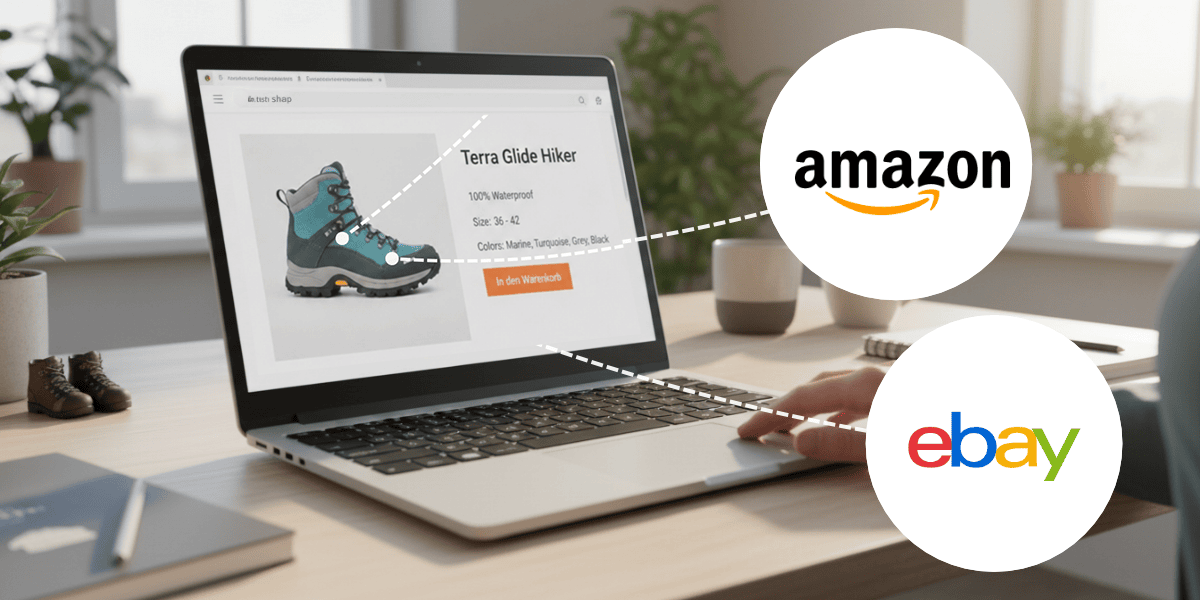
With Channel Pilot Pro Are you preparing your Product data tailored to different markets and sales channels up. You define rules for prices, titles, categories, and attributes centrally and automatically play your optimized feeds Marketplaces and Price comparison websites That way, you can efficiently reach the Swiss market without having to adapt your product data for each channel individually.
You want to know how well your product catalog is prepared for the Swiss market?
We will look at your setup together.
The most important questions and answers
As a rule, yes, if they are legally on the market within the EU. Special rules apply to categories such as medical devices or cosmetics.
Not for most industrial products; import duties have been abolished since 2024. However, customs declaration remains mandatory.
This depends on the sales channel. Anyone who generates at least CHF 100,000 in annual sales through small consignments directly will be subject to tax. In the case of platform sales, the platform can be considered a service provider.
TWINT, credit card and ideally purchase on account.
Often there is no initial fee. Instead, you pay a commission on the items sold. However, the exact conditions vary depending on the marketplace.
Sophie
Content & Social Media Marketing Managerin
Sophie writes about e-commerce, digital retail, and everything related to marketplaces. She tracks trends, analyzes developments, and breaks down even complex topics in an easy-to-understand way. As a trained editor, she brings a keen sense of language, storytelling, and target audiences—and applies these skills today in content and social media marketing at Channel Pilot Solutions. When she’s not brainstorming new content ideas, she loses herself in a good TV series or works up a sweat exercising.