
“Find me the best laptop under €1,000.” The AI handles the research, comparisons, and selection. What used to sound like sci-fi is becoming real. Companies like OpenAI, Shopify, and PayPal are clearly pushing the topic forward and testing new ways of shopping.
What is agentic commerce and how does it work?
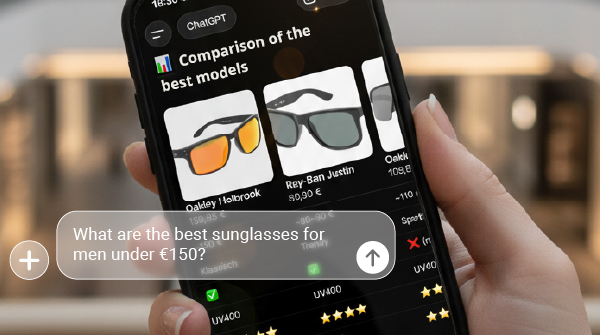
In agentic commerce, an AI takes over key parts of the purchasing process—more and more autonomously. Instead of clicking through online stores, users state their goal: budget, brand, category.
The agent analyzes offers, compares options, and prioritizes results. To do that, it pulls from different data sources, evaluates the information, and turns it into concrete recommendations. In early scenarios, the AI can even initiate orders on its own.
How is agentic commerce evolving right now?
Development is clearly gaining momentum. According to PwC, AI agents could influence up to 15% of European e-commerce revenue by 2030.
On the retailer side, things are moving too: around one in two retailers is already engaging with agentic AI, and roughly 20% are using first solutions.
At the same time, the starting point of product search is changing. Traditional entry points like Google, online shops, or marketplaces are increasingly being complemented by AI platforms such as ChatGPT and Google Gemini.

“In product discovery, the entry point is shifting: instead of classic online shops and marketplaces, AI-powered interfaces are increasingly coming to the forefront. Shops remain central—but they are evolving more into the place where transactions happen, rather than the primary starting point for product discovery.”
Ralf Priemer
CEO Channel Pilot Solutions
What does “agentic” mean?
“Agentic” describes systems that can act independently— specifically: understanding goals, making decisions, and executing actions.
In e-commerce, this becomes a digital shopping agent. Instead of merely executing commands, the AI interprets a request and independently develops a solution path.
What payment methods are possible?
For AI agents to shop, payment processes need to be automated. Possible approaches include digital wallets, saved payment profiles, or token-based authorizations.
Companies like PayPal are already testing such models. At the same time, security and regulation remain central topics.
What are the benefits of agentic commerce for retailers?
For retailers, a new discovery layer is emerging in e-commerce. Products won’t only be found via Google or marketplaces, but also via systems that independently analyze and prioritize offers.
That shifts the focus:
-
-
- Visibility is determined less by the shop frontend and more by product data quality.
-
-
-
- AI agents don’t work with landing pages—they work with structured information: attributes, pricing, availability.
- The better that data is prepared, the higher the chance of appearing in recommendations.
-
CTA (placeholder): How well is your product data optimized? Our experts will review it. Learn more now.
How well are your product data optimized?
Our experts will run the check.
What challenges does agentic commerce bring?
Product information often comes from different systems, exists in different formats, and isn’t consistent. For AI agents to compare offers reliably, this data must be standardized and enriched. The main bottleneck remains data quality.
Additional challenges include:
-
-
- trust in automated decisions
-
-
-
- payment security
-
-
-
- regulatory requirements
-
-
-
- integration into existing system landscapes
-
How can retailers prepare?
If you provide information in a standardized, machine-readable way, you create the foundation for visibility in agentic systems. Product feeds play a central role here.
It’s also worth reviewing existing processes: Where do data silos appear? Which information is missing or inconsistent? If you clean this up, you’ll have a clear advantage.
Reality check: How close are we really to agentic commerce?
Agentic commerce is evolving quickly – first applications are already visible, and the potential is huge. At the same time, implementation remains complex.
One tension is becoming especially clear: while agentic commerce depends on open product data, large marketplaces are increasingly trying to control access by external AI agents.
Platforms like Amazon and eBay are already taking action against autonomous shopping agents – for example through legal steps, updated terms of use, or access restrictions. The core driver is the desire not to give up central value-creation areas such as product discovery, advertising, and transactions.
At the same time, it’s becoming likely that access will increasingly be governed via controlled interfaces, partnerships, and APIs – rather than open web access.
The result: free access to product data is being restricted. For retailers, it becomes even more important to use structured, intentionally provided data feeds in order to stay visible in agentic systems.
More information on product data optimization can be found here.
Questions?
Feel free to contact our experts!
FAQ
Not quite. Even though the terms are often mixed up. Agentic AI broadly describes AI systems that can act independently, make decisions, and execute actions. Agentic commerce is a concrete application of that in e-commerce.
Here, companies use the technology to automate processes such as product search, comparison, or selection. Put simply: agentic AI is the principle; agentic commerce is the use case in e-commerce.
The difference is less about the request – and more about who does the work.
In classic e-commerce, users search for products, compare offers, and make decisions themselves. In agentic commerce, this part shifts:
• Define the goal
• AI analyzes offers
• Products are evaluated
• A recommendation is produced
• Optional: the AI executes the purchase
The focus clearly shifts away from manual searching and toward automated decision logic.
An AI agent evaluates multiple factors at once – and weights them differently depending on context. These can include price, product reviews, delivery time, shipping cost, or individual preferences.
Rather than simply picking the cheapest option, the AI determines the best overall choice for a specific request. The result isn’t random – it’s a prioritized recommendation based on structured data.
At the core is an AI agent that interprets user requests and makes decisions based on them. To do that, it connects to different data sources—such as marketplaces, product feeds, or internal databases. The AI analyzes the information, compares offers, and generates a recommendation.
An agentic commerce protocol describes technical interfaces through which AI agents communicate with shops, marketplaces, or other systems.
These protocols allow product data, pricing, or availability to be retrieved in a standardized way. The goal is for AI agents to process information efficiently and make well-founded decisions.
Partly. At least in certain scenarios. AI agents can already support product search and decision-making today, and they will continue to expand that role.
Fully automated purchases where the AI places orders independently are still the exception. Trust, security, and user oversight remain decisive.
Without structured product data, agentic commerce doesn’t work. AI agents make decisions based on machine-readable information. In practice, however, this data comes from different sources, exists in different formats, and is often inconsistent.
For reliable comparisons, product data must be standardized, enriched, and provided consistently.
Yes, significantly. When AI agents select products, the focus shifts from classic web pages to structured, machine-readable data.
For companies, that means: visibility is no longer driven only by content and rankings, but increasingly by the quality and availability of product data. If you get this right, you’ll remain visible – even in an agentic environment.

Sophie Makkus
Sophie schreibt über E-Commerce, digitalen Handel und alles, was sich rund um Marktplätze bewegt. Sie beobachtet Trends, ordnet Entwicklungen ein und bringt auch komplexe Themen verständlich auf den Punkt. Wenn sie nicht gerade an neuen Content-Ideen tüftelt, verliert sie sich in einer guten Serie oder powert sich beim Sport aus.