Sophie
The best tools for marketplace integrations: 12 systems compared
You sell through your own online store and now want to get started on Amazon, eBay or OTTO as well? Or you are already active on several marketplaces and realize that managing them consumes more and more time?
This is where tools for connecting to marketplaces come into play. They connect your online store or inventory management system with the sales channels and, in the best case, take away a large part of your daily workload.
But which tool is right for your business? We compare twelve solutions, highlight their strengths, and explain what you should consider when choosing one.
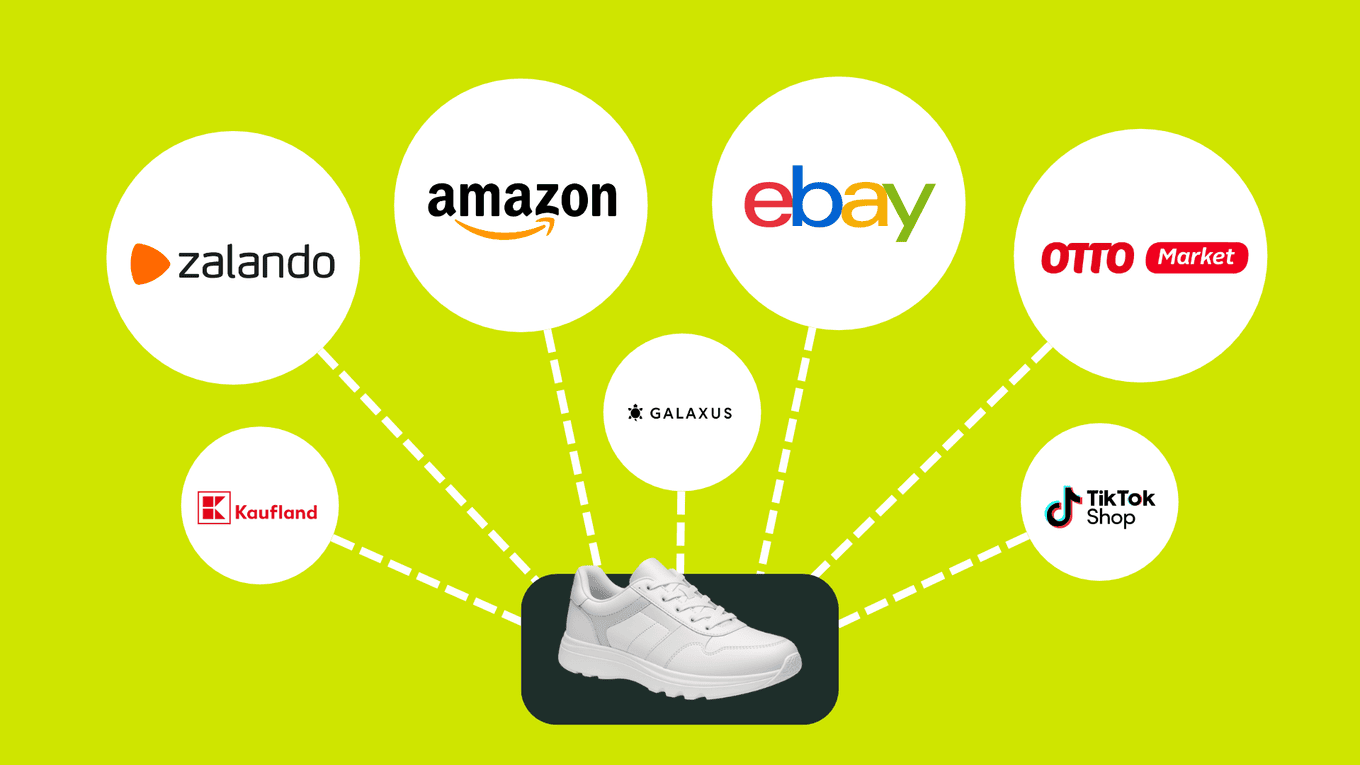
The best tools for marketplace integrations: What solutions are there?
Not every merchant needs the same software. Those who only want to sell their Shopify products on eBay have different requirements than a company that offers 100,000 items on ten European marketplaces.
Therefore, it is worth considering first, where most of the work is done:
- When connecting new marketplaces? You want to offer your products on other platforms without having to set up each item individually.
- Regarding orders and shipping? Orders come from various channels and need to be processed centrally.
- Regarding product details and prices? Every marketplace requires different information, and your prices should adjust automatically as much as possible.
There are different solutions for these tasks. We have divided the twelve providers into three categories. The transitions are smooth: some tools cover several areas at once.
Shop integration and order processing: tools for less manual work
You have a functioning online shop and would like to offer your products on Amazon or eBay now. Of course, you could upload each item manually. With ten products, that might still work. With several hundred, it quickly becomes tedious.
It becomes even more complex when the first orders arrive: inventories must be adjusted, invoices must be generated, and shipping information must be reported back.
These three tools help you simplify such processes.
| Tool | What can the tool do? | When is it worth it? |
|---|---|---|
| magnalister | Connects shop systems such as Shopify, Shopware and WooCommerce with marketplaces. Products, prices, stock levels and orders can be synchronized. | If you want to manage your marketplaces directly from your existing shop as much as possible. |
| Billbee | Consolidates orders, invoices, and shipping processes. Inventory can also be reconciled and recurring tasks can be automated. | If you already sell through multiple channels and would like to save time, especially when processing orders. |
| Afterbuy | Unifies marketplace listings, inventory management, and order management. Supports Amazon, eBay, Kaufland, and OTTO, among others. | If you want to manage offers, orders and inventory in a common software. |
The most important difference: magnalister focuses primarily on the connection between the shop and marketplaces. Billbee focuses more on the work after the purchase. Afterbuy connects several tasks of daily business operations.
So which solution is better depends on where you are currently wasting the most time.
Retail and ERP: Tools for warehouse and marketplace sales
Imagine that you sell the same item through your online store, Amazon, and Kaufland. There are still five units left in stock. Within a short time, six orders come in through various channels.
If your systems do not communicate reliably with each other, you have a problem: you are selling more goods than are actually available.
At least when orders, inventory levels, and shipping processes become increasingly complex, it pays to look into a warehouse management system with a marketplace connection.
| Tool | What can the tool do? | When is it worth it? |
|---|---|---|
| JTL-Wawi with JTL-eazyAuction | Combines retail management and marketplace sales, among others for Amazon, eBay, OTTO and Kaufland. | If you want to manage products, inventory, and orders centrally via JTL. |
| plentyONE | Cloud ERP for product data, inventory, orders, and multi-channel sales. According to the provider, more than 150 sales channels are available. | If you want to closely link your marketplace sales with warehouse and trading processes. |
| Unicorn 2 | Supplemented by JTL-Wawi with connections to other marketplaces. | If you are already working with JTL and would like to open up additional sales channels without having to change your ERP system. |
So it’s not just about making products visible on marketplaces. What’s crucial is that Sales, warehousing and shipping work together.
Unicorn 2 plays a special role in this: The tool does not replace a WMS system, but rather extends an existing JTL environment.
Feed Management and Marketplace Integrators: When each marketplace has different requirements
Amazon wants other product titles than eBay. At Zalando, size and variety play an important role. And when you sell internationally, additional requirements may apply depending on the country.
As long as you only offer a few products, you can still adjust many things manually. With several thousand items on different marketplaces, this is hardly practical anymore.
This is where feed management tools and specialized marketplace integrators come in. They help you manage product data centrally and prepare it appropriately for each sales channel.
| Tool | What can the tool do? | When is it worth it? |
|---|---|---|
| Channel Pilot Pro | Connects feed management, marketplace integrations, and dynamic pricing in one platform. Supports 180+ national and international marketplaces. | If you sell products on multiple marketplaces both nationally and internationally, you want to efficiently manage large product catalogs and control product data and prices centrally and automatically. |
| Lengow | Offers international marketplace and marketing connections as well as solutions for price analyses and dynamic price recommendations. | If you want to open up new markets and sales channels. |
| Channable | Generates product data on a regular basis for marketplaces and advertising platforms. Also offers marketplace integrations and advertising automation. | If you want to optimize product data for both marketplaces and your online advertising. |
| Tradebyte | Specializing in fashion and lifestyle, it reportedly offers more than 90 marketplace connections. | For example, if you sell fashion and need to manage many sizes, variants, and industry-specific product information. |
| novomind iMARKET | Integrates marketplaces into existing IT and commerce systems and automates product listing integration. | When you want to connect complex systems together as a brand, manufacturer, or larger retailer. |
| Mirakl / Mirakl Connect | Mirakl offers software for companies that want to build and operate their own marketplace. Mirakl Connect, on the other hand, is aimed at retailers and brands that want to centrally manage product catalogs, offers, and orders across different marketplaces. | If you want to sell on multiple marketplaces (Mirakl Connect) or if you want to build your own marketplace as a company (Mirakl Marketplace Platform). |
What should you consider when choosing a marketplace tool?
You now know the different types of tools and their strengths. But how do you find out which solution actually suits your business? It’s not just about what features a provider promises; it’s also about how well they integrate with your existing processes.
These four questions will help you make a decision:
- Are your most important marketplaces supported?
You want to expand into France? Then a long list of German marketplaces will be of little use to you. Check which sales channels can be connected in your target countries and whether all the necessary features are available. - Does the software work with your existing systems?
Whether it’s Shopify, Shopware, or your own ERP: Your new solution should be as smoothly integrated as possible. Specifically, clarify which data will be automatically transferred and whether you need additional interfaces. - How reliable is the automation?
Just because a tool synchronizes inventory, that doesn’t necessarily mean it happens in real time. Ask about update intervals, potential inventory gaps, and how to handle faulty product data. Because even with automatic synchronization, overstocking cannot be completely ruled out. - How much effort remains hanging over your team?
Let us show you how to set up new products, fulfill marketplace requirements, and troubleshoot errors. Because a solution with many features is of little value if your team still has to constantly intervene manually.
Our tip: Test the software using your own product data and a typical use case. This way, you can quickly see if it actually simplifies your processes.
Channel Pilot Pro: Marketplace integrations, feed management, and dynamic pricing in one system
Imagine you sell on Amazon, OTTO, Kaufland, and several international marketplaces. Each channel has its own requirements for your product data. At the same time, you want to keep your prices competitive and process orders as efficiently as possible.
For that, you could use various individual tools. Alternatively, you could use a solution that combines several of these tasks.
This is where Channel Pilot Pro comes into play. The platform combines three key areas:
- Feed Management: You combine product data from your shop, ERP, or PIM and prepare it with rules and formulas for the various sales channels.
- Marketplace integrations: You connect your systems to the desired marketplaces. Order management allows orders, returns, and inventory information to be exchanged between the systems.
- Dynamic Pricing: You can control your prices using individual rules, taking into account, for example, competitive prices and your margin requirements.
The advantage in everyday life: You don't have to manually edit the same product data for each marketplace or make price changes manually across multiple platforms.
Also in the User reviews on OMR Reviews Channel Pilot Pro scores positively in several areas. The flexible data fields and formulas, as well as the fast support, are particularly praised.
How the expansion of the marketplace business can look in practice is shown by our Success story of Werkzeugstore24The retailer has expanded its marketplace business from two to over 16 marketplaces using Channel Pilot Pro.
You want to know how Channel Pilot Pro can support your marketplace business? In a non-binding consultation, we will look at your requirements together and determine the possibilities for your e-commerce.
Frequently asked questions about tools for marketplace integrations
There are various solutions that you can use to connect your Shopify store to marketplaces. These include, for example, magnalister and Channel Pilot Pro. Both of these allow you to synchronize product data, prices, and inventory, as well as exchange orders between marketplaces and Shopify. The available features depend on the respective marketplace and its setup.
The difference lies primarily in the broader functionality: While magnalister is focused on connecting and managing marketplaces from within the shopping system, Channel Pilot Pro combines marketplace connectivity with feed management and dynamic pricing. This is particularly interesting if you Large product catalogs manage, prepare data for different sales channels and your Dynamically control prices based on competitive data if you want to.
Yes, for many solutions you don’t need any programming skills. Channel Pilot Pro makes getting started easy, for example with pre-configured plugins for shop systems like Shopify, Shopware, and WooCommerce. Numerous marketplaces also already have ready-made interfaces available. You don't have to develop every connection yourself.
Not every provider provides freely accessible test access. Instead, some offer a personal demo. Therefore, ask if you test with your own product data You can find out which features are available and whether there are any costs involved. With Channel Pilot Pro, you can discuss your requirements in a personal demo.
Sophie
Content & Social Media Marketing Managerin
Sophie writes about e-commerce, digital retail, and everything related to marketplaces. She tracks trends, analyzes developments, and breaks down even complex topics in an easy-to-understand way. As a trained editor, she brings a keen sense of language, storytelling, and target audiences—and applies these skills today in content and social media marketing at Channel Pilot Solutions. When she’s not brainstorming new content ideas, she loses herself in a good TV series or works up a sweat exercising.